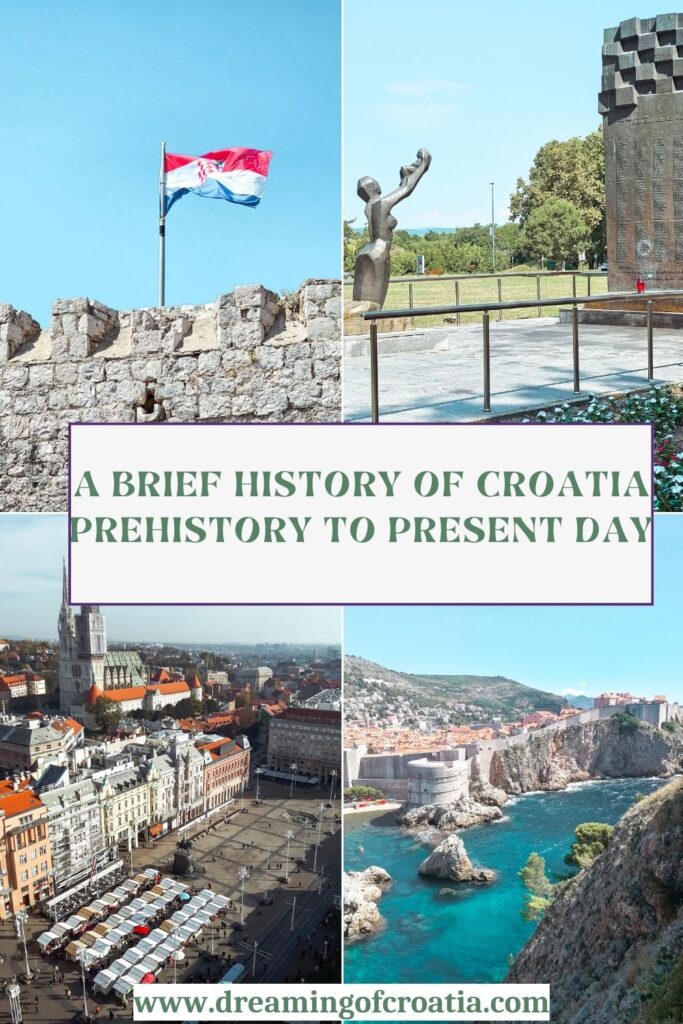
A Brief History of Croatia: From Prehistory to Present Day

If you’re travelling to Croatia soon, or you’re generally interested into the history of our country, in this blog post I will explain to you a brief history of Croatia.
As a Croatian with a Master’s degree in History, I have a strong and vast knowledge of Croatian history and the most important events throughout that have shaped our country as you see it today.
For writing this blog post, I used my knowledge, online sources and the book I own titled 21. knjiga, Hrvatska Povijest by Ivo Goldstein, our most popular Historian.
I wrote this blog post on a brief history of Croatia in a simplified and understandable way, without going into much details and debates. So, after reading this blog post you will have a basic knowledge of Croatian history which will allow you for further exploration if you feel so.
The blog post is written in a chronological way, starting from prehistory and finishing with Croatia in the present day.

Croatia Travel Plan
If you’re looking for a custom Croatia travel plan, find out more about my personalised itinerary service.
Heads up! Some links in this blog are affiliates. If you click and buy, I may earn a small commission at no extra cost to you. Rest assured, I only recommend stuff I’ve tested or trust. You can read more about our affiliate disclaimer here.
Travel Resources for Croatia:
⭐️ Join my Croatia Travel Tips FB Group to ask questions, get advice and engage with our community.
Prehistoric Croatia
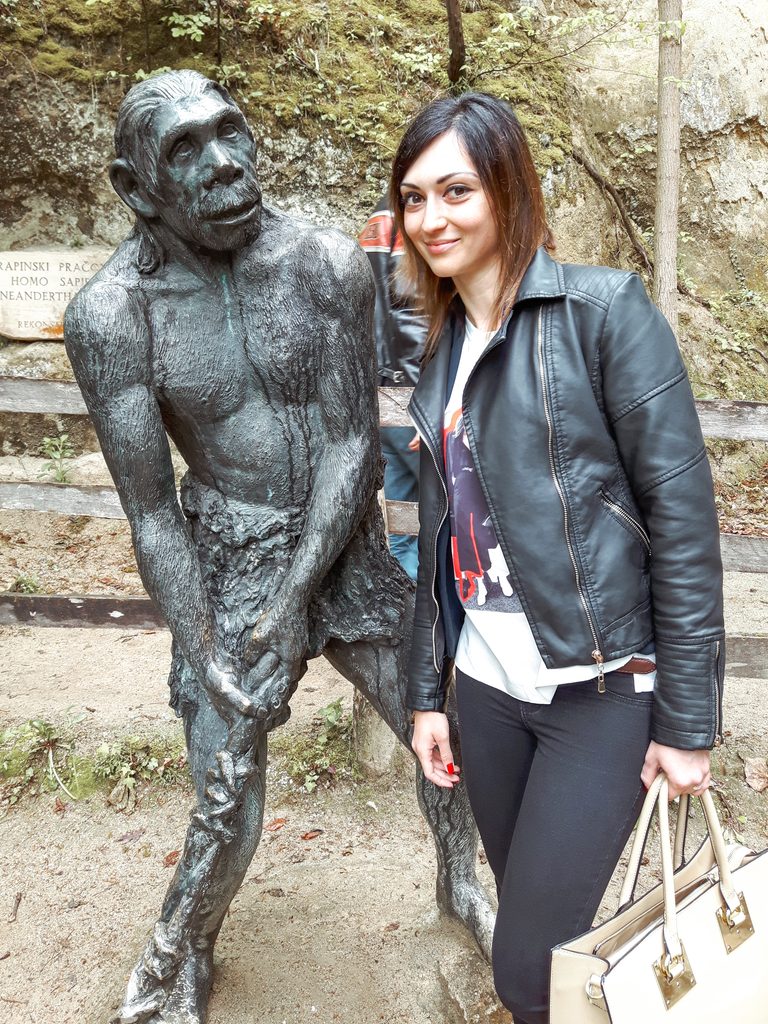
The earliest traces of human presence in Croatia date back to the Palaeolithic Age, some 130,000 years ago.
The reason we know that is because of the Krapina Neanderthal Site on Husnjakovo Hill in Krapina, near Zagreb. Not only this confirmed that our history started in prehistory already, but the discovery was also quite revolutionary because of the bones that were found.
About 900 human fossil bones were found and upon testing it was confirmed that they belong to both Neanderthals and Human Sapiens which proved that we were mixing (a reason why 1%-2% of individuals with European or Asian ancestry carry Neanderthal DNA!).
In the Neolithic period we had Impresso, Danilo and Hvar cultures, but our most popular Eneolithic culture was Vucedol, found in Vukovar in eastern Croatia. The prehistoric site was named The Troy of the Danube which is presumed to have emerged after the arrival of Indo-European settlers around 3000 BC and lasted until about 2000 BC. Its characteristics include new metalwork procedures, extremely skilled ceramics and the calendar marked on ceramic vessels.
The Iron Age in Croatia began around 800 BC, when iron tools became widely produced and used. This was also when the first distinct ethnic communities appeared, most of them Illyrian.
Ancient Croatia: Illyrians, Greeks and Romans
Illyrians were the oldest peoples that have lived in the modern day Croatian territory, about 10 different tribes. For example The Histri were the Illyrian tribe that inhabited today’s Istria, hence the name, whereas The Liburnians were living in the northeastern Adriatic regions and were considered the best seafarers on the Adriatic coast.
The Dalmatae were the Illyrian tribe that inhabited Dalmatia and therefore was often in fight with Romans, who gave the name Dalmatia after them.
Greeks came in the 6th century BC and formed colonies, among the two most popular ones: Issa and Pharos, modern-day islands of Vis and Hvar.
With the ever growing power of the Roman Republic, the Illyrians formed the union, but after the war with Rome in 228 BC they weakened which ultimately led to the Romans conquering the territory and making Illyria a Roman province, one was called Dalmatia and the other one was Pannonia (eastern Croatia).
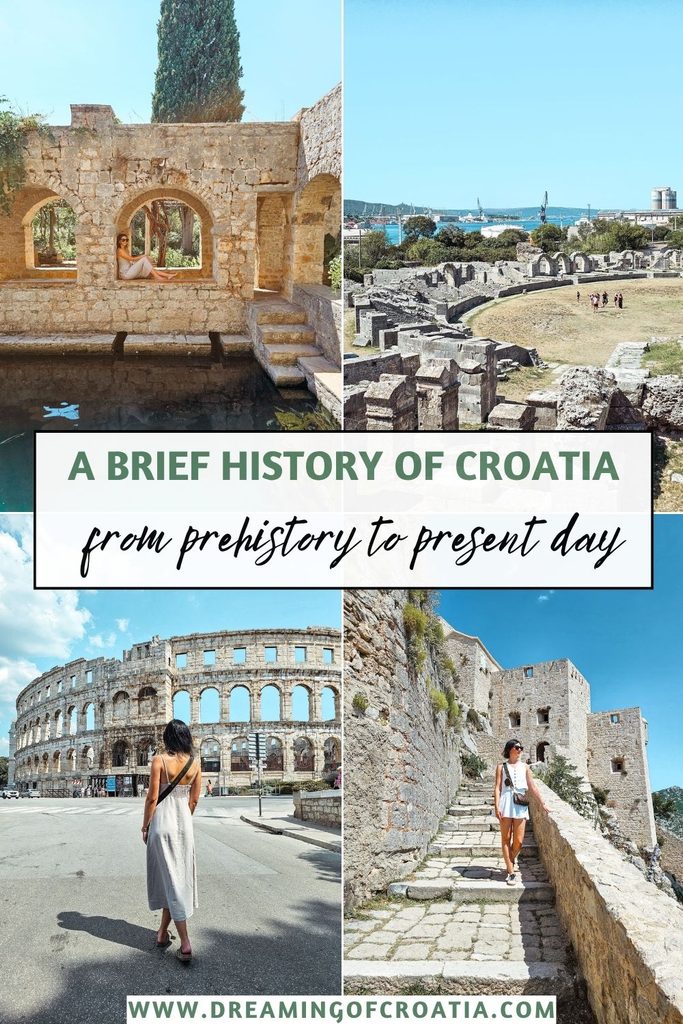
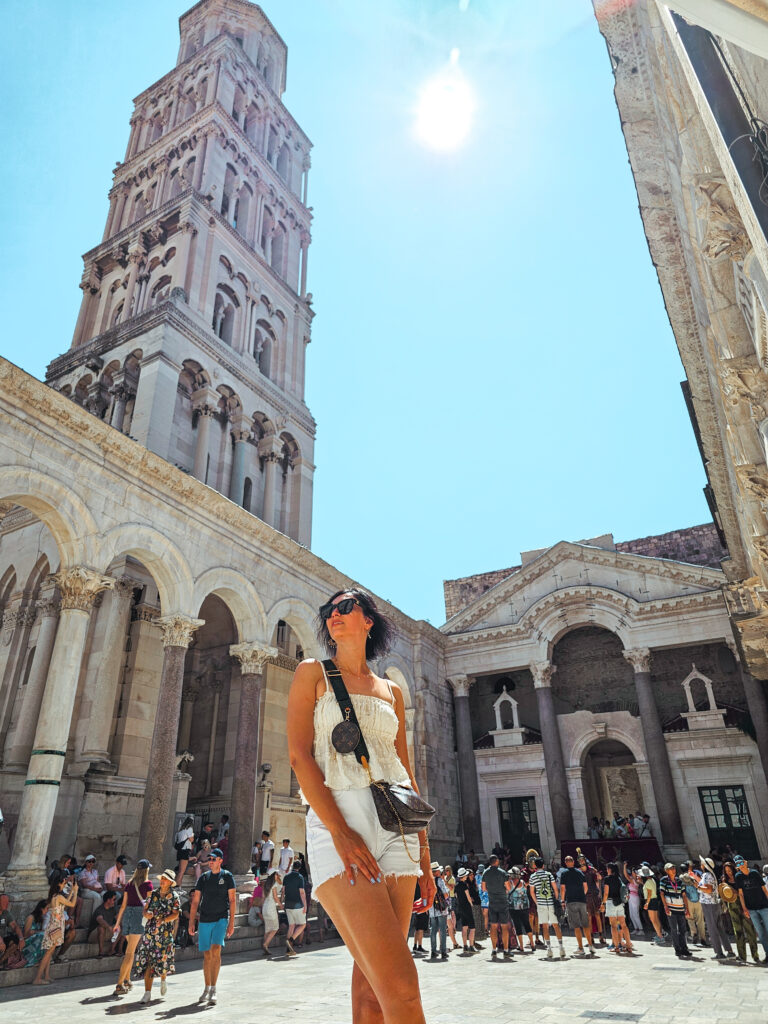
Which is to no surprise that we have many Roman archaeological sites in Croatia, the most notable Diocletian’s Palace in Split, Amphitheatre in Pula and Salona ancient town near Split.
Not to mention that some Roman emperors were born and/or lived in modern-day Croatia, such as Diocletian (born in Salona), Valentinian I and Valens, the latter two from Cibalae (today’s Vinkovci in eastern Croatia).
The Fall of Rome and the Arrival of Croats
Of course we all know that Rome weakened significantly due to the internal instability, which gave the opportunity for the barbarian tribes to attack the lands owned by the Roman Empire.
Because the Roman province of Pannonia was on the way from the central steppes towards Rome, it was attacked by Goths and Alans and in the 5th century Pannonia was ruled by Attila the Hun.
The Roman Empire was eventually divided into 2 parts and the modern-day Croatia fell under the East Roman Empire and the Byzantine culture. But, the area was in constant political and economic crisis which enabled Slavs and Avars to enter and conquer the lands.
In the 7th century Croats came to these lands and started making settlements, which is when our history officially starts and why Croatia is called the way it is.
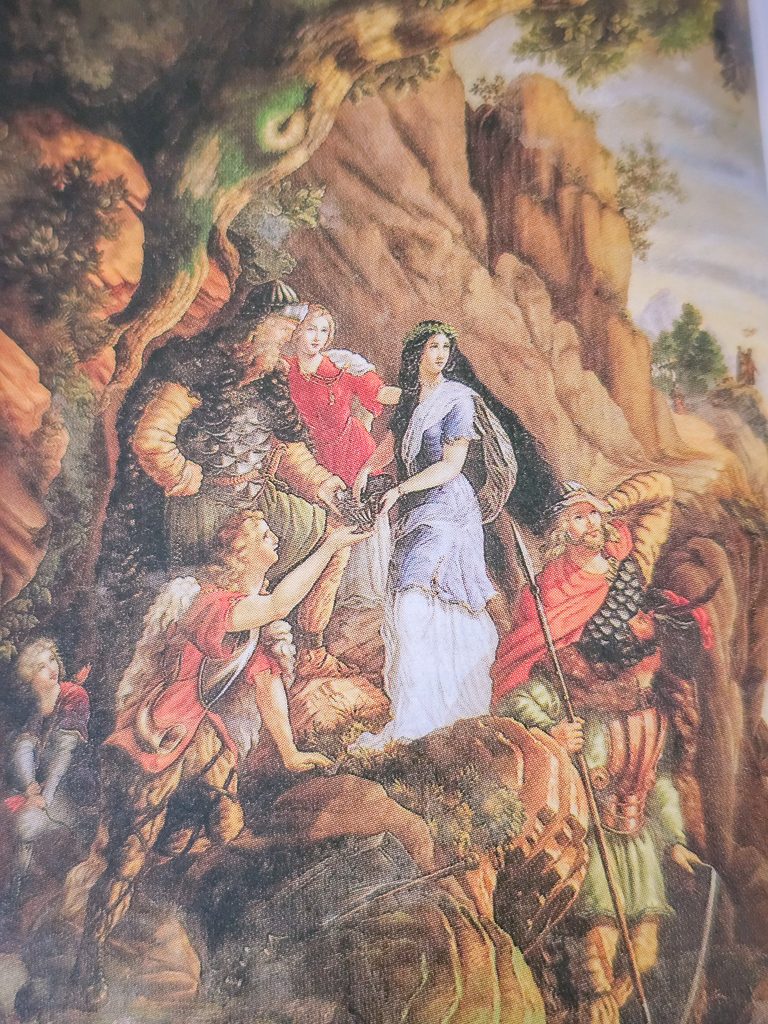
There is even a nice legend about the arrival of Croats which says that 5 brothers by the name of Klukas, Lobelos, Kosjenc, Muhlo and Hrvat alongside 2 sisters Tuga and Buga arrived in Croatia and it is how the country was founded.
Hrvat was the leader of the group, which is why our country got the name after him: Croatia in Croatian is Hrvatska and Croat is Hrvat.
The Medieval Kingdom of Croatia
To me, this was always the most exciting and intriguing part of Croatian history.
One of the first notable Croatian rulers was the Duke Trpimir I who founded the Trpimirovic dynasty, which ruled in Croatia from around 845 until 1091 (with some interruptions). During Trpimir’s reign he ordered The Charter of Duke Trpimir, also known as Trpimir’s Deed of Donation, which is the oldest preserved document of the Croatian law and the first national document which mentions the name of Croatia.
Trpimir’s throne was usurped by Domagoj who took it and expelled Trpimir’s sons. He fought successfully with the Venetians and was called The Worst Duke of the Slavs.
Branimir was another important Duke in our history because during his reign Croatia received the papal recognition as a state from Pope John VIII in 879.
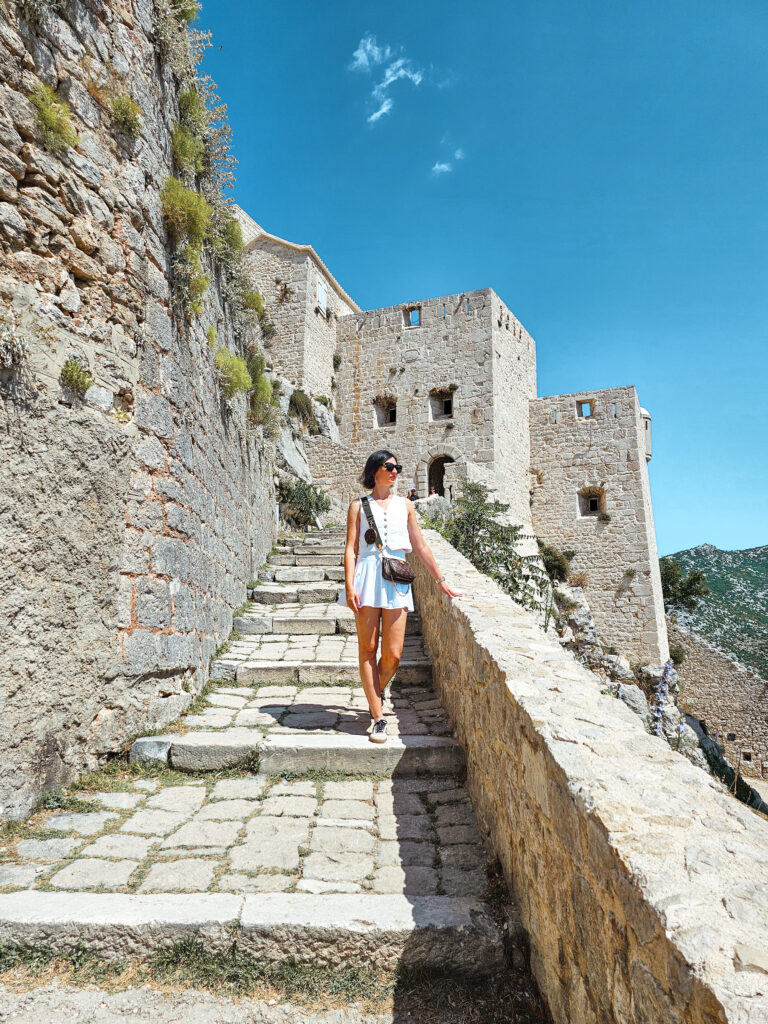
However, the most important moment in our (medieval) history was when Tomislav was crowned as the First King of Croatia in 925 and when the Medieval Kingdom of Croatia was formed. He ruled from Klis Fortress and Biograd na Moru. Klis Fortress was already established as the seat of Croatian duchy by Duke Mislav, so it’s not surprising that it stayed as the seat of the throne when Croatia became kingdom.
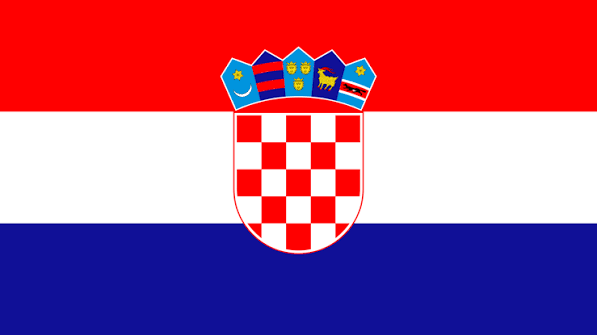
King Stjepan Drzislav is famous because there is a legend that he won the chess game against Venetian Doge Pietro II Orselo during his captivity and that is how not only he was let go but also why Croatia has a checkerboard on its flag. Of course, the legend was never confirmed, but it is a nice fun fact if you ask me!
The 11th century is considered as the peak of the Early Middle Ages for the Croatian kingdom as we had many great rulers during this period.
Petar Kresimir IV is an important king because he unified Pannonia and Dalmatia into one territory.
Our last king was Demetrius Zvonimir who ruled Croatia until 1089. He was the first Croatian king to be crowned with regalia – crown, sceptre, sword and flag. One of the most important monuments in Croatia, The Baska Tablet, was gifted by Zvomimir to the Benedictine Church of St. Lucy in Jurandvor in Krk island. The tablet is written in glagolitic script, which is the first monument that mentioned the name of Croatia in Croatian. Today it is kept at the Croatian Academy of Sciences and Arts.
📖 Read my Croatian Flag Meaning: History, Symbols & Legend Explained blog post.
Croatia and the Personal Unity with Hungary
King Zvonimir died in 1089 under unknown circumstances. But, there is a popular legend circling called the Curse of King Zvonimir.
According to legend, Zvonimir refused to send people to the Crusade Wars which was negatively received. Zvonimir was therefore betrayed and killed by his own people. On dying bed, he cursed Croatians to never again have the Croatian ruler, which happened to be the case for almost a thousand years (up until Croatian independence in 1991).
However, what historically did happen after Zvonimir’s death was that he left the throne without direct successors, so he was succeeded by Stephen II, the last one from the Trpimirovic dynasty, but he ruled briefly until his death in 1091.
As King Zvonimir was married to his distant relative Jelena, the sister of Ladislaus I of Hungary there were fights over who was going to sit on the throne.
After a famous Battle of Gvozd Mountain in 1097, fought between Croat Petar Snacic who self-identified himself as the king of Croatia, and Hungarian king Coloman who won the battle, Croatians signed Pacta Conventa in 1102 which created a personal unity between Croatia and Hungary.
This ultimately meant that Croatia was now part of the Hungarian kingdom and therefore ruled by Hungarian rulers.
A Divided Croatia: Venice, Dubrovnik and the Ottoman Empire
For centuries Croatia was divided between certain powers, mostly the Venice Republic, Republic of Ragusa and the Ottoman Empire, who fought for the domain of our lands.
Venice was constantly trying to rule over the Dalmatian cities and the coast. In the early 15th century Croatian-Hungarian King Ladislaus of Naples was starting to lose his political power and it was obvious to him that he may not be able to keep certain territories, like Dalmatia.
Therefore, in 1409, after months of negotiation, Ladislaus sold Dalmatia to Venetians, who kept Dalmatia under their rule up until 1797 when Napoleon conquered lands (we will come to that part!).
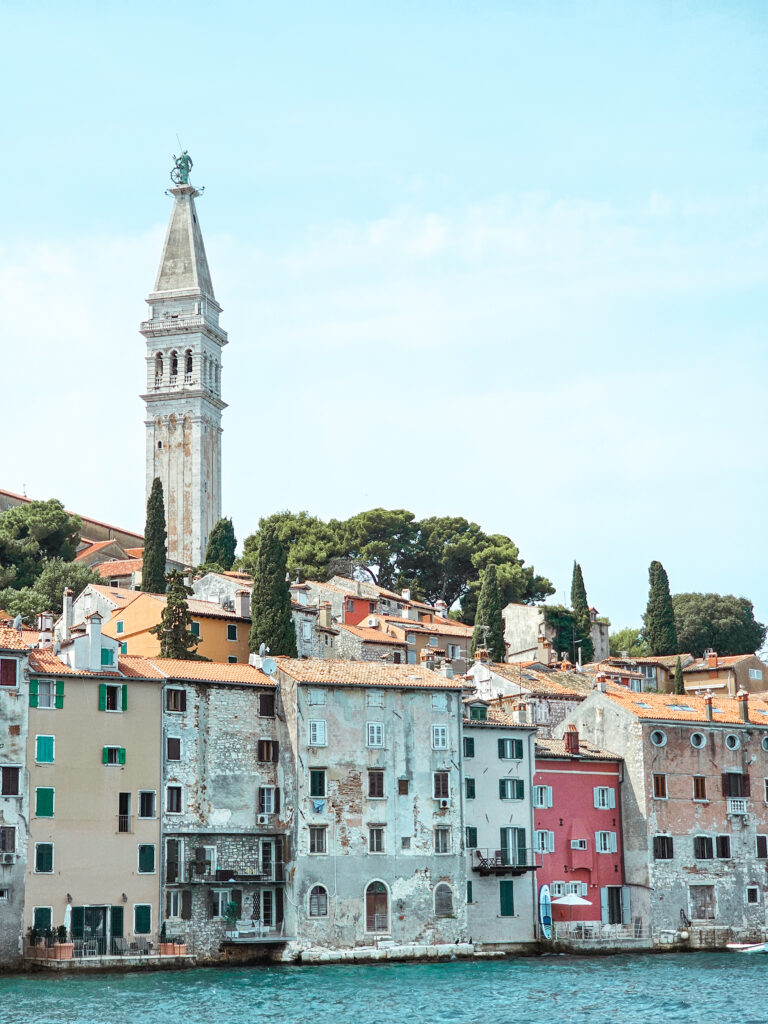
Because both Dalmatia and Istria were under the Venetian rule for centuries, this influence is reflected in the architecture, especially Istrian cities, such as Rovinj that largely resemble Venice.
The constant fight over power of the Adriatic Sea and the maritime trade routes was fought between Venice and the Republic of Ragusa aka today’s Dubrovnik. It was a strong and prosperous republic, which was successful economically, politically and culturally. The Republic of Ragusa existed from 1358 until 1808 when it was conquered by Napoleon.
However, the most threatening power to the Croatian-Hungarian Union and its territories was the Ottoman Empire. There were 4 important battles with the Ottoman Empire over the course of a few centuries that defined Croatian history.
The first one was the Battle of Krvava Field in 1493 when Croatian ban Emerik Derencin attacked the Ottoman army under the command of Hadim Yakup Pasha, even though he was advised not to. The battle was disastrous for Croatians and was considered one of the bloodiest battles ever fought because a lot of nobility was killed in it. Even though there were no immediate territory losses, the battle is considered the beginning of the fall of Croatian power over its lands.
The Battle of Mohacs took place in 1526 between Hungarian King Louis II and the Ottoman Sultan Suleiman the Magnificent. It resulted with the defeat of the Hungarian army. The Croatian nobility was frustrated with the weakened Hungarian kingdom, so in January 1527 they chose the Habsburg king Ferdinand I as their ruler. From that moment Croatia got under the Habsburg Monarchy together with Hungary and therefore the Personal Union ceased to exist.
The Siege of Szigetvar happened in 1566 and was fought between the Habsburg Monarchy under the Croatian ban Nikola IV Zrinski and the Ottoman army under the command of Suleiman the Magnificent. Both Nikola Zrinski and Suleiman died in the battle, but the importance of the battle was considered so great that it is often described as the battle that saved the Western civilisation.
The last but not least important battle of this period was the Battle of Sisak in 1593, which resulted with the Croatian-Habsburg victory. This battle is considered the turning point of wars with the Ottoman Empire which started to lose its power, influence and territories in the Balkans.
As you can see, this period of 4-5 centuries was very turbulent in Croatian history and resulted in loss of many historical territories, which is why we refer to this part of our history as The remnants of the remnants of the once great and glorious Kingdom of Croatia.
Croatia under the Habsburg Monarchy
As mentioned in the previous chapter, after the disastrous Battle of Mohacs in 1526, some of the Croatian nobility wanted to break the Personal Union with Hungary and choose Habsburg King Ferdinand I as a Croatian ruler.
There were two sides formed, one wanting to choose Hungarian John Zapolya and stay in the Union and the other one was for breaking the Union and becoming a part of the Habsburg Monarchy under Ferdinand I.
Eventually at the election in Cetin in January 1527 the assembly of the Croatian Parliament voted for Ferdinand I and as a result the Kingdom of Croatia was integrated into the Habsburg Monarchy.
The period under the Habsburg rule was under the constant threat of the Ottoman Empire and battles to keep the territory under the Habsburg rule.
After the disastrous and biggest defeat of the Ottoman army at the Battle of Vienna in 1683, the Croatian army started liberating its territories, especially in the region of Slavonia which was mostly occupied by the Ottomans. People started migrating back and the muslim population either escaped or got christianised and assimilated into the Croatian society.
It is also the time of the awakening of the Croatian national identity and the idea of separation from the Habsburg Monarchy. A lot of the Croatian nobility was frustrated with the current situation, especially the noble families of Petar Zrinski and Fran Krsto Frankopan who started the Magnate conspiracy, also known as the Zrinski-Frankopan Conspiracy.
The conspiracy was crushed and both Zrinski and Frankopan sentenced to death in 1671, but it started the Croatian national revival which will define next centuries.
The 18th century under the Habsburg rule brought improvements within the society.
An especially prosperous and developing time for Croatia was under the reign of Maria Teresa. She introduced the urbars, which legally regulated and capped the feudal obligations and manual labor. She also introduced compulsory primary education and banned witch trials and persecutions.
Joseph II succeeded her and took the reforms much further, which is why he is known as the Revolutionary Emperor. He is most known for abolishing serfdom in 1785, even though in Croatia this officially happened in 1848 (we’ll come to that!). He also issued the Edict of Tolerance, granting religious freedom and equal civil rights in the dominant Catholic Croatia.
The Napoleonic Era
Sadly, after the death of Joseph II a lot of the reforms were pushed back and the Hungarian political power over Croatia was increasing, what is often called as the magyarisation.
But the new power was dominating Europe at that time, and that was of course Napoleon Bonaparte.
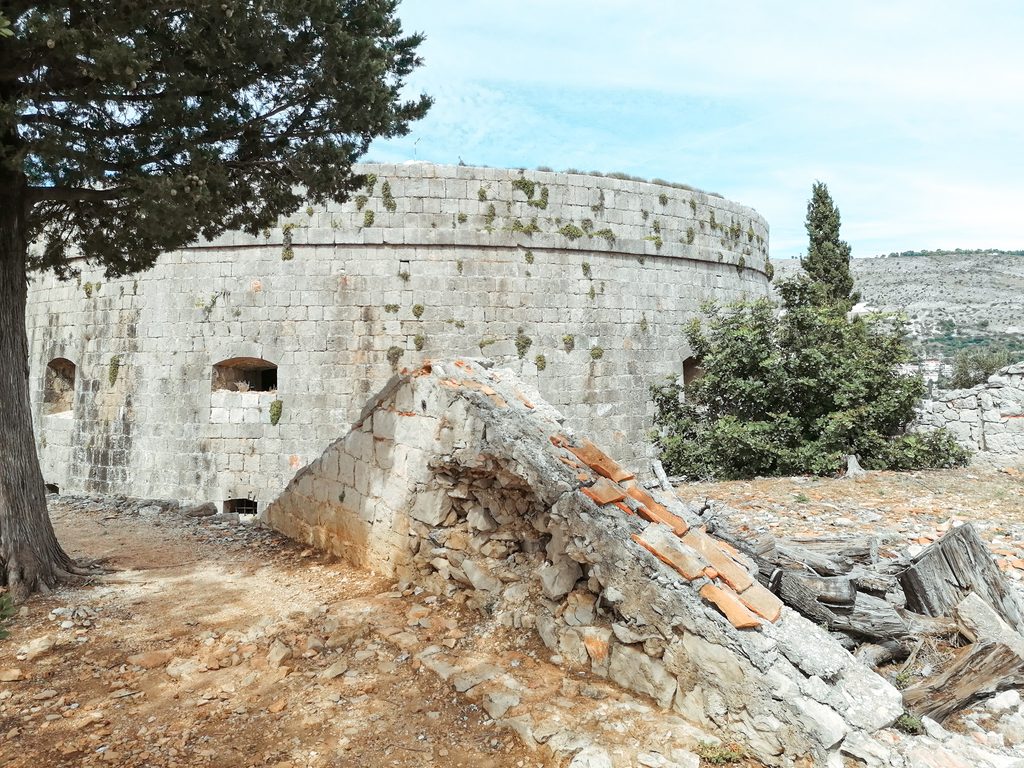
The French army was fighting with the Habsburg Monarchy, and as a result they conquered Istria and Dalmatia (which Habsburg Monarchy got in 1797 after the fall of the Venice Republic). In 1808 Napoleon’s army entered the city of Dubrovnik and took it over, which resulted in the disappearance of the autonomous Republic of Ragusa. Napoleon also conquered mid Croatia and formed the Illyrian provinces.
One of the most notable reforms during the Napoleonic era was building of the roads, some of which we still have today.
However, after Napoleon’s major defeat at the Battle of the Nations in 1813, the French Empire rapidly disintegrated. The Austrian Empire launched military campaigns to retake Illyrian provinces and Dalmatia in 1814.
The Croatian National Revival and Austria-Hungary
The 19th century was a time of the Croatian national revival. The pan-Slavic Illyrian Movement started in 1830 and its main leader was Ljudevit Gaj.
He published Croatian-Slavonic Orthography, which paved the way to modern Croatian orthography. In 1834 he also published the Croatian News, the first newspaper to be written in Croatian language.
Another notable figure in the Illyrian Movement was Janko Draskovic, who opened the institution to promote literacy and knowledge in Croatia in the national language. He wrote Dissertation in 1832, the first Croatian political program where he asked for the unification of all Croatian, Slovenian and Bosnian territories into the autonomous Kingdom of Illyria under the Habsburg Monarchy and the official language to be Croatian Shtokavian dialect (which is today).
However, the most important Croatian figure of this period is Ban Josip Jelacic. He is famous for a lot of reasons. Firstly, he officially abolished serfdom in 1848. He also played an important role in the 1848 Revolution, when he fought against Hungary’s attempts to bring Croatia under its control. His military campaign helped bring the Hungarian Revolution to an end.
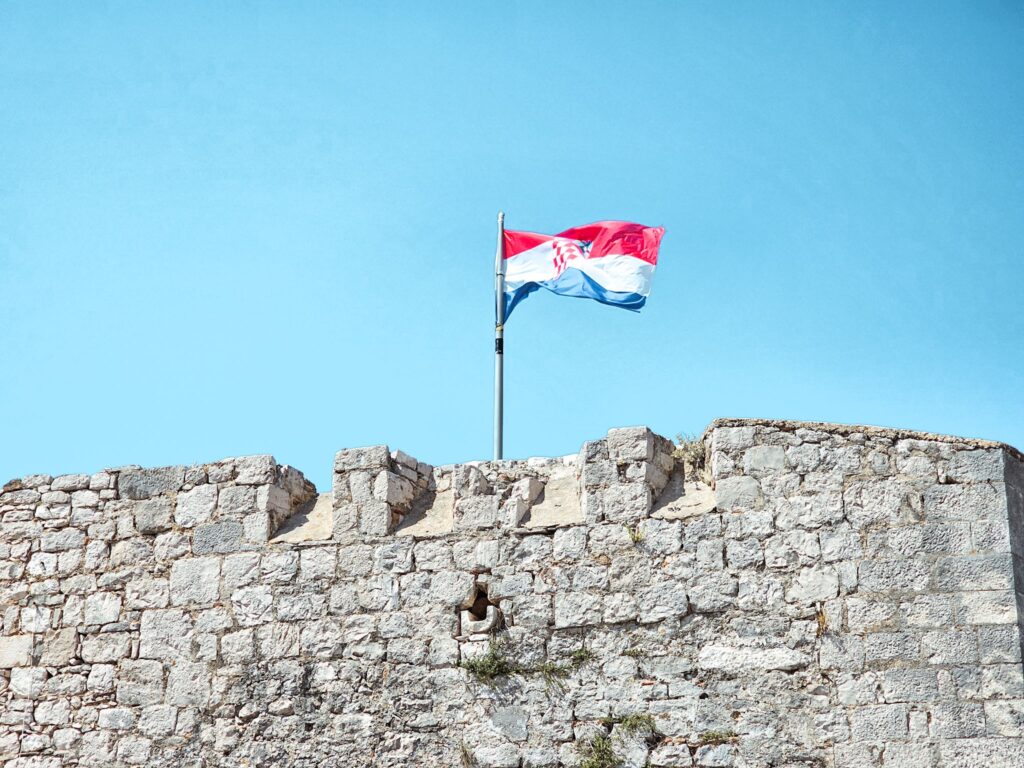
However, the most important historical achievement was the unification of Croatian lands and the introduction of the tricolour red-white-blue flag during his installation ceremony in 1848.
And lastly, he elevated the Bishopric of Zagreb to an Archbishopric, which resulted in freeing the Croatian Church from Hungarian control.
Another important political figure was Ante Starcevic who formed a political Party of Rights which asked of the integrity of Croatian lands and the right for self-determination. Because of that he is considered as our Father of the Nation.
In all of this national revival and the effort of Hungary to become independent from the Habsburg Monarchy, a new monarchy was formed in 1867 – Austrian-Hungarian Monarchy.
At its core was the dual monarchy with two separate parliaments and each with its own prime minister, but they shared a common monarch.
The Kingdom of Croatia was the autonomous region under the Hungarian crown. Although many Croatians opposed this decision, eventually it was accepted in 1868, and so Croatia would remain a part of the Austrian-Hungarian Monarchy under Hungary until 1918 when First World War broke.

Croatia during World War I
World War I started in 1914 when Archduke Franz Ferdinand of Austria was assassinated by Gavrilo Princip in Sarajevo.
When the war started, Croatia was still a part of the Austrian-Hungarian Monarchy and fought on their side. However, the power of the monarchy was weakening and the rise of Croatian national thought was ever growing.
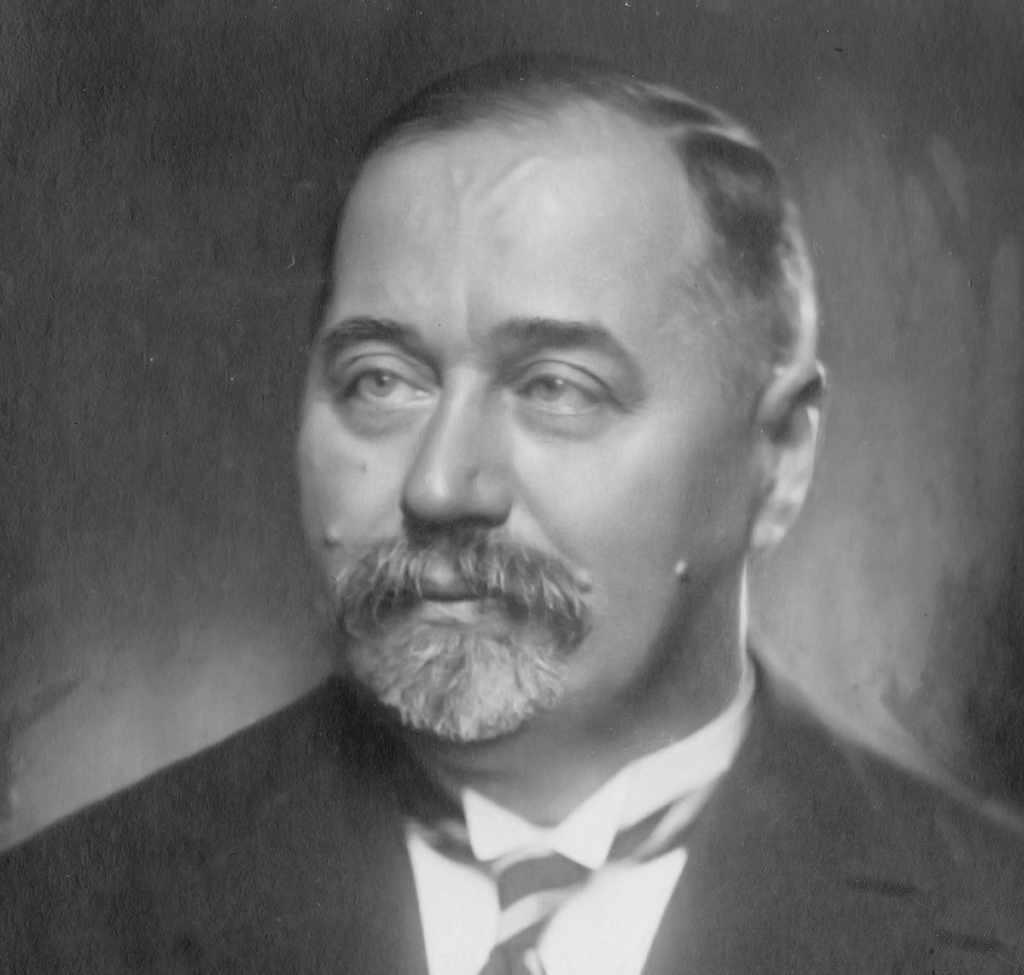
Towards the end of the war, Croatians finally saw the opportunity to break out from the centuries long oppression under Austria and Hungary and to found its own state. One of the most prominent political figures was Stjepan Radic who founded the Croatian Peasant Party because he argued that peasants deserve the right to vote too.
In the years of the WW1 it was obvious that Croatia wants a separation and its own state, but most politicians, led by Svetozar Pribicevic believed that a union with Serbia and Slovenia is the best way to go.
At the National Council of Slovenes, Croats and Serbs in November 1918 Stjepan Radic famously said not to rush like geese into fog, meaning not to go into the new state without proper guarantees for Croatian autonomy, clear conditions of the union and a plan for the future. Sadly, his warning turned out to be prophetic, but we’ll come to that!
Stjepan Radic was heavily outvoted, removed from the central committee and so the delegation rushed to Belgrade. Therefore, on December 1 1918 the unified Kingdom of Serbs, Croats and Slovenes was proclaimed.
Croatia in the First Yugoslavia
Shortly after the formation of the First Yugoslavia the Vidovdan Constitution was enacted on June 28 1921. The constitution was passed by a simple majority vote in the Constitutional Assembly and not by the consensus-based majority.
Ultimately, this meant that the power of the Serbian monarch was centralised, Croatian parliament was abolished for the first time in its history and the traditional Croatian borders were abolished and instead divided into 33 new administrative oblasts governed directly from Belgrade.
Stjepan Radic was very proactive in this period and was openly against this centralisation. He illegally went to other European cities, such as London, Paris, Vienna, Moscow where he tried to seek help from western powers with no success. Eventually, he even formed a coalition with Svetozar Pribicevic to fight together for equality and democratic rights of Croatia within the state.
Unfortunately, at the National Assembly of the Kingdom of Serbs, Croats and Slovenes in Belgrade on June 20 1928, Stjepan Radic was assassinated by Punisa Racic. He died few weeks later from the wounds.
On January 6 1929 King Alexander I enacted the January 6 Dictatorship which completely transformed the First Yugoslavia.
He suspended the Vidovdan Constitution, dissolved the parliament and banned all political parties, labor unions and regional or ethnically focused organisations. It was a royal dictatorship with one clear goal – to create one single Yugoslav nation. The name immediately changed from the Kingdom of Serbs, Croats and Slovenes to the Kingdom of Yugoslavia.
All of this led to the forming of the Ustasa, a Croatian Revolutionary Movement and a fascist organisation led by Ante Pavelic. Their stated goal was the destruction of Yugoslavia and the creation of an independent, ethnically pure Croatian state.
Throughout 1930 they operated training camps abroad, largely funded by Benito Mussolini and launched terrorist attacks inside Yugoslavia. Their most notable action was the 1934 assassination of King Alexander I in Marseille.
On the other radical side there was Josip Broz Tito, who was a member of the Communist Party of Yugoslavia.
Just before WW2 started, on the basis of the Cvetkovic-Macek Agreement, the Banate of Croatia was formed on August 26 1939. It was a monumental turning point that granted Croatia unprecedented political autonomy.
Croatia during World War II
When WWII broke out, Croatia was still a part of the Kingdom of Yugoslavia, but that didn’t last too long. On April 6 Axis powers started attacking Belgrade and a few days later they entered Zagreb and liberated Croatia from the Kingdom of Yugoslavia.
On April 10 1942 Slavko Kvaternik declared the Independent State of Croatia, shortly called NDH. Its president was Ante Pavelic. It is important to emphasise here that NDH was a fascist state supported by Italy and a puppet-state to Nazi Germany.
Sadly, about 80,000 Serbs, Jews, Roma, Muslims and political opponents were killed in Jasenovac concentration camp, close to Zagreb.
Because NDH was supported by Mussolini for years, Pavelic had to pay it back and so at the Treaties of Rome on 18 May 1941 he gave Dalmatia, Croatian Littoral and parts of Gorski Kotar to Italy, even though mostly Croatian people inhabited these regions. It’s needless to say that this was negatively received by many Croatians.
During the years of WW2, there were two different parties trying to defeat NDH. One of them were Cetniks organised by Draza Mihailovic. They were actively fighting and killing Croatians. On the other side was the communist Partizan party led by Josip Broz Tito.
All 3 of them; Ustase, Chetniks and Partizans were fighting each other over the lands and the future of its territories. But, the global events and the course of World War II played a huge role in how the situation in Croatia was developing.
On 8 September 1943 Italy capitulated and the Partizans liberated most of Dalmatia with Split and all the islands, Istria and Croatian Littoral.
The State Anti-Fascist Council for the National Liberation of Croatia (ZAVNOH) was established in 1943. It was the supreme governing organ of the anti-fascist movement in Croatia during World War II, and it laid the legal and political foundations of federal Croatia within the post-war Yugoslav federation.
With the fall of Nazi Germany, the fate of NDH was also defined. On 8 May 1945 Partizans entered Zagreb and liberated it from the Ustasa. Ante Pavelic managed to escape and fled to Argentina.
The Bleiburg repatriations took place in May 1945, when British forces in Austria returned thousands of Axis soldiers and collaborators to Yugoslavia. Many were forced on death marches, executed without trial or sent to labour camps, where others died in harsh conditions. The events were named after the Austrian town of Bleiburg where the British first refused their surrender.

Croatia in Socialist Yugoslavia
After WW2 Croatia has found itself as one of the six nations forming the Socialist Yugoslavia and was closely tied to the Soviet Union.
It soon became clear that Croatia is again under the dictatorship of one-party rule that was led by Josip Broz Tito. It was yet again one of the darker periods in our history where a lot of people were either imprisoned or disappeared over the night for the “unknown” reasons.
In 1947 Paris Peace Treaties were signed which confirmed Istria, Rijeka, Kvarner islands and Dalmatia as Croatian regions, so they were formally integrated into Socialist Yugoslavia.
In 1948 Tito split with Stalin because he refused to allow Yugoslavia to become a subservient satellite state of the Soviet Union. Stalin expelled Yugoslavia from the Cominform (international communist organisation) and expected Yugoslavia to collapse shortly or for Tito to be overthrown.
However, Tito got sympathisers within Yugoslavia and secured financial and military aid from the West. He then co-founded the Non-Aligned Movement with India and Egypt. This has successfully positioned Yugoslavia as a neutral buffer state throughout the Cold War.
Similar to the national revival of the 19th century, Croatia was at its second stage. It started with the Declaration on the Name and Status of the Croatian Literary Language, which was published in 1967. It is considered one of the most critical cultural milestones in socialist Croatia, as it openly challenged Yugoslavia’s state-enforced linguistic unitarism.
The Declaration was followed by the Croatian Spring, which was a political and cultural reform movement of 1971. It was led by the reformist factions of the League of Communists of Croatia, most notably by Savka Dabcevic-Kucar and Miko Tripalo. The movement was mainly asking for equality, especially economical.
While the movement was suppressed, it fundamentally reshaped Yugoslavia. To appease the underlying frustrations and prevent future uprisings, Tito incorporated many of the economic and political decentralisation demands of the Croatian Spring into the 1974 Yugoslav Constitution.
This constitution granted the republics veto powers over federal decisions and recognized their theoretical right to self-determination, which ultimately served as the legal framework for Croatia’s declaration of independence in 1991.
A few years later, on 4 May 1980 Tito died and the new chapter for Croatia was on its way.

The Croatian War of Independence
After Tito’s death, Yugoslavia was on the verge of collapsing, especially because of the weakening of the Soviet Union.
Croatian politicians used this opportunity to try to break the ties with Yugoslavia and seek independence. In the 1990 there were referendums held, but the main referendum was held on May 19 1991 when Croatia voted for its independence led by Franjo Tudman.
This was a historic mandate because it gave the Croatian Parliament the democratic legitimacy to formally declare independence a month later on June 25 1991.
The Yugoslav People’s Army attacked Croatia and so the War of Independence, also called here as the Homeland War, began.
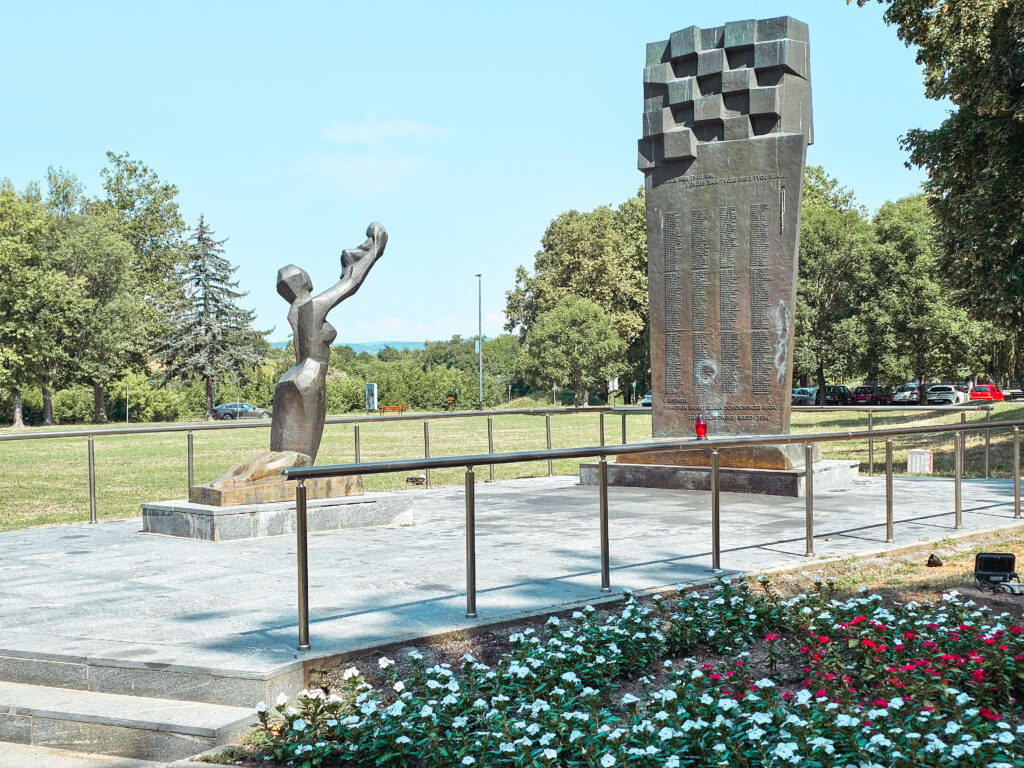
One of the major and most devastating battles was the Battle of Vukovar, an 87-day siege of the eastern Croatian city of Vukovar. It fell on November 18 1991 and in its aftermath many Croatian wounded soldiers and civilians were killed in a nearby pig farm in Ovcara.
Even though the Battle of Vukovar was the most devastating battle in the West since 1945 and brought us a defeat, ultimately the defense of Vukovar was a critical strategic victory. By tying down the JNA’s main force for three months, it bought crucial time for the rest of Croatia to train and equip its army.
Today we commemorate the fall of Vukovar – 18 November is a national holiday in Croatia, officially called the Day of Remembrance for the Victims of the Homeland War and the Day of Remembrance for the Victims of Vukovar and Skabrnja.
Another devastating military campaign conducted by the Yugoslav People’s Army was the shelling of Dubrovnik between October 1991 and May 1992. The assault drew global outrage because it targeted a UNESCO World Heritage Site that possessed no significant military value.
On 15 January 1992, all member states of the then European Community (EC) recognised the Republic of Croatia as a sovereign and independent state. Croatia’s admission to the United Nations on 22 May 1992 crowned the international recognition of the Republic of Croatia.
In 1995 two major battles decided the War of Independence for Croatia – Operations Flash and Storm. Operation Flash was executed from May 1 to May 3 1995 and liberated western Slavonia.
Operation Storm was carried from 4-7 August 1995 which brought us a victory. Which is why we are celebrating Operation Storm yearly on August 5, and it’s a non-working day for most Croatians.
The Erdut Agreement was the landmark peace accord signed on November 12 1995, that officially brought a peaceful end to the Croatian War of Independence. Eastern parts of Croatia were then peacefully integrated in 1998.
📖 Read my 15 Croatian Celebrations to Experience Throughout the Year blog post.
Croatia Since Independence
Ever since independence Croatia has become a more and more prosperous country. We transitioned from socialism to market economy and started on post-war construction. It’s an ongoing process, but we can see progress every day.
On April 1 2009 Croatia joined NATO, which secured the national safety and fulfilment of a major foreign policy goal while keeping democratic values.
Another major event was joining the European Union on July 1 2013, which opened Croatia even more to the western European markets. Additionally, we adopted euro as a currency and joined the passport-free Schengen Zone on January 1 2023.
Croatia is today focused on developing its country, promoting tourism and building a better future for its citizens.
Croatian history was not always the shiniest, but it was always diverse and dynamic which can be seen in our daily life, culture and architecture.
Where to Stay in Croatia
Here are some bucket list hotels to check during your stay in Croatia:
- Hotel Excelsior Dubrovnik – beachfront, with the views of the Old Town
- Grand Park Hotel Rovinj by Maistra Collection – most beautiful hotel in Istria region
- Plitvice Holiday Resort – luxury glamping resort near Plitvice Lakes
- Esplanade Zagreb Hotel – historical art-nouveau hotel in Zagreb
- Vila Vinkomir Kutjevo – villa in the Kutjevo vineyard and winery
Croatia Travel Plan
If you’re looking for a custom Croatia travel plan, find out more about my personalised itinerary service.
Like this post? Pin it!📍